

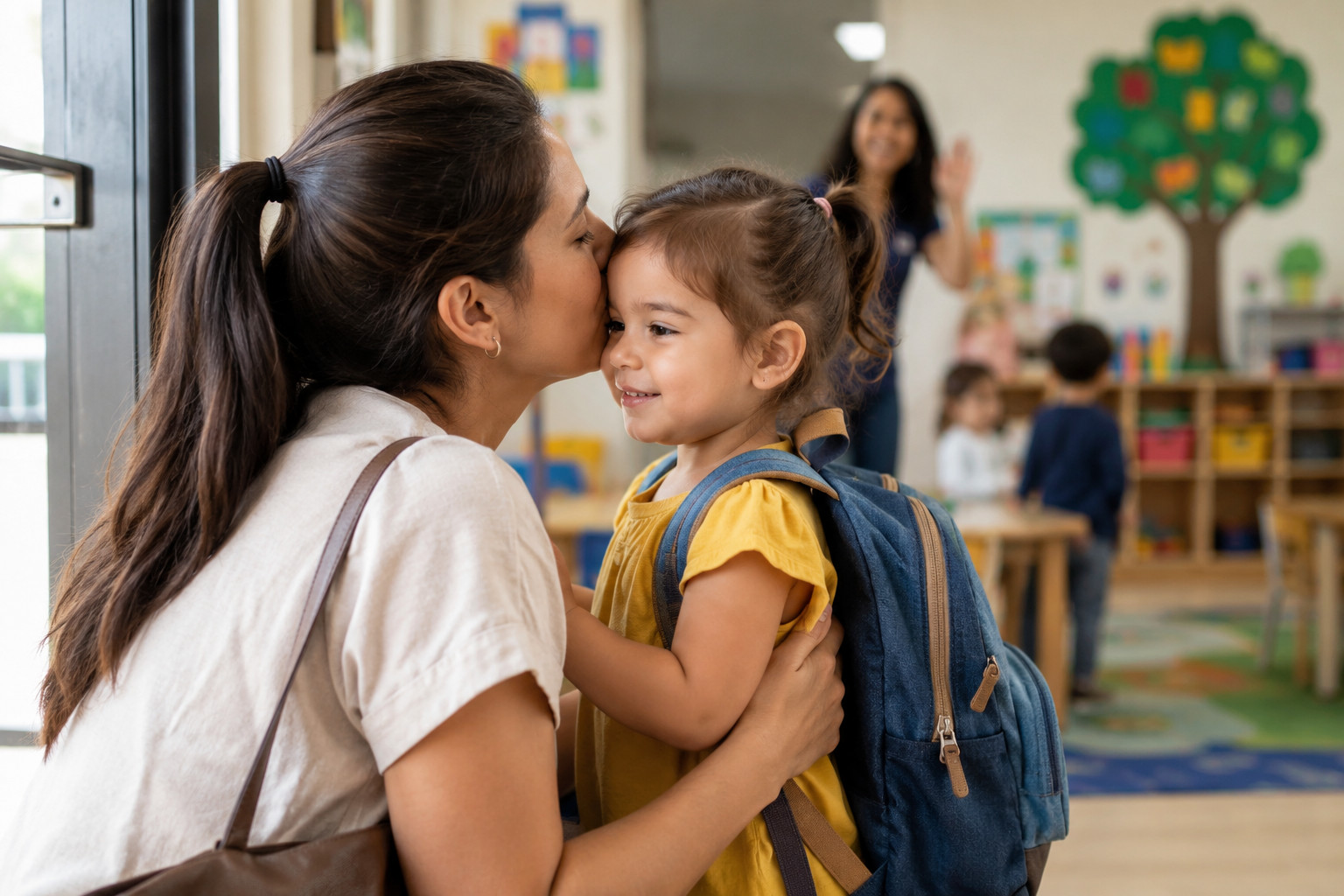
You’ve packed the bag, labeled everything, talked about the new classroom, and prepared for the first day. Then you arrive at the door, your child realizes you’re leaving, and suddenly all that preparation comes down to one moment:
saying goodbye.
For some children, that goodbye is surprisingly easy. For others, there may be tears, tight hugs, or a very determined request for you to stay.
Both can be completely normal.
The goal of the first drop-off isn’t to prevent every tear. It’s to help your child begin learning something important: you can leave, they can be safe and cared for, and you will come back.
When a child becomes upset, a parent’s natural instinct may be to stay a little longer.
One more hug.
One more explanation.
One more minute until they calm down.
But extending the goodbye can sometimes make separation harder. Your child may begin wondering whether you’re actually leaving or whether crying will make you stay.
Instead, try creating a simple goodbye routine.
A hug, a kiss, a reassuring phrase, and then go.
Something as simple as:
“I love you. Have a wonderful day. I’ll see you after school.”
The exact words matter less than being calm and consistent.
It can be tempting to quietly leave while your child is distracted, especially when you want to avoid tears.
But children benefit from knowing that goodbye means goodbye.
When a parent suddenly disappears, a child may become more concerned about where the parent went or begin watching closely to make sure it doesn’t happen again.
A clear goodbye helps build predictability.
Even when your child is unhappy about the separation, they begin to understand the pattern: Mom or Dad says goodbye, I stay here, and they come back later.
That pattern becomes familiar with repetition.
Young children pay close attention to the adults they trust.
They notice your face, your voice, your body language, and even your hesitation.
You don’t need to pretend that the first day isn’t emotional. It may be emotional for you too. But showing confidence in the transition can help communicate that this new environment is a safe place.
A warm smile and a confident goodbye can say something your child may not yet have the words to understand:
“I trust the people who are taking care of you.”
Instead of focusing heavily on the separation, talk about what comes next.
“You get to see your classroom.”
“Maybe you’ll paint today.”
“I wonder what you’ll play with outside.”
These small comments can shift attention from Mom or Dad is leaving to something interesting is about to happen.
Just be careful not to create promises you can’t control. You don’t need to promise that they won’t cry, that they’ll make a best friend today, or that every moment will be fun.
Let the day unfold naturally.
This is an important one for parents.
A child may cry during drop-off and be happily playing a short time later.
The goodbye is often the difficult part—not necessarily the entire day.
Once children enter the classroom routine, see familiar teachers, find an activity, or become interested in what other children are doing, their attention can shift surprisingly quickly.
This is also why communication between families and teachers is so valuable. Knowing how your child settles into the day can make the transition easier for everyone.
Some children adjust after a day or two. Others need more time.
There is no perfect timeline.
Your child is learning a completely new rhythm: new adults, new children, new sounds, new routines, new expectations, and time away from the people they know best.
That’s a lot to take in.
Consistency helps make all of those unfamiliar things gradually become familiar.
The classroom they weren't sure about becomes their classroom.
The teacher they just met becomes someone whose voice they recognize.
The children around them become familiar faces.
And the morning routine that once felt completely new begins to feel like a normal part of their day.
A successful first drop-off doesn't necessarily mean there were no tears.
Sometimes success looks like a child crying, receiving comfort from a teacher, eventually becoming interested in an activity, enjoying part of the day, and seeing their parent return exactly as promised.
Then they do it again tomorrow.
And little by little, something changes.
The goodbye becomes more familiar.
The classroom feels more comfortable.
Trust begins to grow.
So when that first drop-off arrives, give them a good hug, remind them that you'll be back, and let their day begin.
Keep the goodbye short, loving, and confident—and give your child the opportunity to discover that they can do this.

6416 W. Ogden Ave.
Berwyn, IL 60402
Monday to Friday - 6am to 6pm
Saturday - Closed
Sunday - Closed

2618 Ridgeland Ave.
Berwyn, IL 60402
Monday to Friday - 6am to 6pm
Saturday - Closed
Sunday - Closed